.png)


Why In-House Production Beats Outsourcing for Expo Builds
- Apr 18
- 4 min read
A lot of companies call themselves exhibition stand builders. Not all of them actually build anything. And if you're about to hand over your brand and your budget to someone, that distinction matters more than you might think.
Here's something the expo industry in South Africa doesn't talk about enough: many companies that market themselves as expo stand builders and exhibition stand designers are, in reality, project managers. They take your brief, design something, mark it up, and hand it to a network of subcontractors and fabricators to produce. The design might be theirs. The build? Rarely.
It's not always disclosed. Most clients don’t think to ask.
At Happinest Custom—one of South Africa's leading exhibition stand builders—we design and build everything ourselves. Our 3,000sqm factory in Cape Town is home to our own team of carpenters, welders, painters, electricians, and CNC operators. We don’t subcontract. We don’t outsource. What we promise, we build. And that changes everything about the experience.
The Problem with Outsourcing Your Build
Outsourcing introduces a chain of dependencies that can quietly unravel a project—and it usually does at the worst possible moment. When a company subcontracts your build, they hand over direct control of the work the moment they sign it off to a third party. They’re now relying on someone else to interpret the design correctly, hold the quality standard, and deliver on time.
If something goes wrong—and in manufacturing, things can always go wrong—they're managing a problem they didn’t create and can’t fully control. A finish that doesn’t match the render. A structural issue discovered on bump-in day. A subcontractor who's overcommitted across three jobs, and yours is the one that slips.
"When we quote a job, we know exactly who is building it, on which machine, in which part of our factory. There are no surprises we don't already know about."
That uncertainty gets passed quietly on to you. You just don’t always find out until it’s too late to do anything about it.

Some of our Happinest crew members celebrating completing a huge project!
What In-House Actually Means
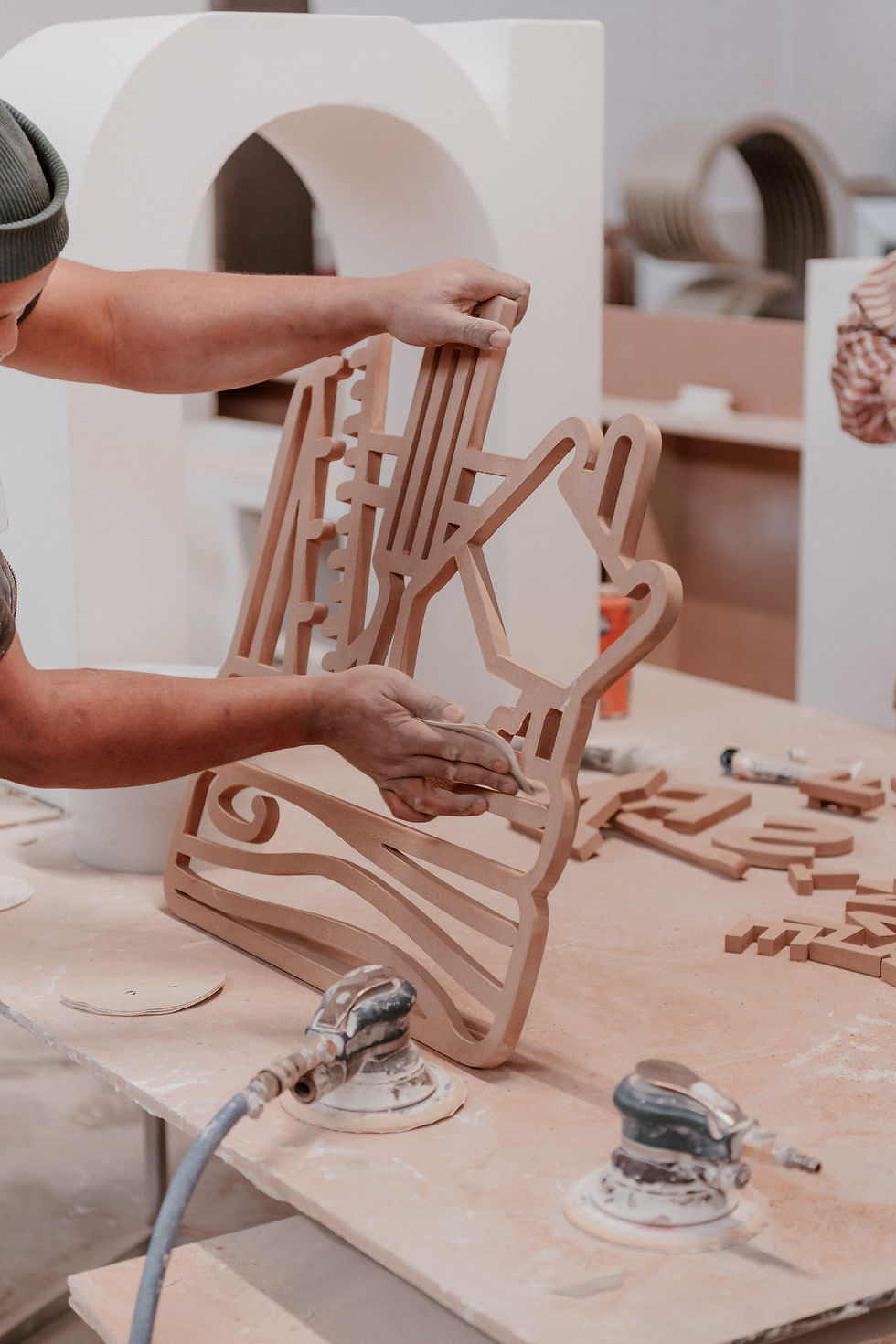
When we say everything is built in-house, we mean it literally. Our 3,000sqm factory houses CNC routers, spray booths, a full carpentry workshop, welding bays, and a dedicated painting facility. Our team covers every trade required to take a project from a 3D render to a finished, installed stand—without the work leaving our hands until it leaves for site.
That means the designer who drew the stand can walk across the factory floor and speak directly to the carpenter building it. A material decision that needs to change on Tuesday can be implemented by Thursday. A last-minute client amend—and there is always at least one—can actually be accommodated because we control every step of the process.
There’s no telephone game. No brief being misread by a fabricator who’s never met the client. No one trying to reverse-engineer an intention they weren’t part of from the beginning.
Quality Control That's Actually Within Our Control
Quality control is only meaningful when the person promising it has the power to enforce it. With an outsourced build, quality checks happen at a distance—if they happen at all. You’re trusting a middleman to hold a third party to a standard they set on your behalf.
With an in-house operation, every stage of the build is visible to us. We inspect work as it progresses, not after it arrives on a truck from an external supplier. If something isn’t right, we catch it and fix it before it becomes your problem—not at 11pm on bump-in night with no solution available.
This is the unglamorous part of expo builds that rarely comes up in a sales meeting. But it’s the part that determines whether your stand opens looking exactly like the render or not.
Speed - The Kind You Can Actually Rely On
Every company in this industry promises fast turnarounds. In-house production is what makes that promise possible to actually keep.
When you’re dependent on subcontractors, your timeline is subject to their capacity, their other clients, and their own priorities. When your build is happening in your own factory, you control the schedule. You can allocate more resources to a project that needs it. You can run parallel workflows. You can extend hours and know it’ll make a real difference.
At Mining Indaba 2026, our team built and installed 13 custom exhibition stands across two exhibition halls in just five days. That’s not achievable by coordinating a network of external suppliers. It’s only possible when every person on the job answers to the same leadership and works from the same factory floor. It’s what separates a genuine expo stand builder from a company that manages the process from a distance.
What This Means When You're Choosing a Builder
When you brief Happinest, you’re briefing the people who will actually build your stand. The team who will flag a structural issue in the design before it becomes a site problem. The people who will be in the factory at 6am if that’s what it takes, and on the show floor at 5am making sure everything is right before the doors open.
That’s not a detail. That’s the whole point.
So before you sign a brief with any expo stand builder or exhibition stand company in South Africa, ask them one simple question: who actually builds this?
If the answer involves phrases like "our trusted supplier network" or "our manufacturing partners"—you now know what that means, and you can factor it into your decision accordingly.
Why Choose Happinest Custom?
Choosing the right exhibition stand builder is crucial. You want a partner who understands your vision and can bring it to life. At Happinest Custom, we pride ourselves on being that partner. Our commitment to quality and speed sets us apart.
We don’t just build stands; we create experiences. Our team is passionate about what they do. We believe in collaboration and communication. That’s how we ensure your project runs smoothly from start to finish.
The Happinest Difference
What makes us different? It’s simple. We control every aspect of the build. From design to execution, everything happens under one roof. This means fewer headaches for you and a final product that exceeds your expectations.
We understand the importance of deadlines. Our in-house capabilities allow us to work efficiently without compromising quality. You can trust us to deliver on time, every time.


Comments